In-House Jewellery Wax Printing for Better Casting
- Nico
- Jul 26
- 5 min read
A fine pavé setting, a sculptural signet or an intricate engagement ring should not lose definition because a wax pattern arrived late, was damaged in transit or required compromises before casting. In-house jewellery wax printing gives professional workshops direct control over the critical step between CAD design and precious metal.
For Sydney jewellers and specialist ateliers, the value is not simply faster prototyping. It is the ability to produce precise, cast-ready wax patterns when the job requires them, assess a design in hand, make considered changes and move into casting with greater confidence. Technology quietly supports excellence when it is selected for the jewellery workflow rather than adapted from another industry.

Why bring wax printing into the workshop?
Outsourcing can be sensible for occasional work or unusually large production demands. Yet it introduces lead times, freight risk and less control over the order in which jobs are resolved. A customer requesting a small adjustment to a custom ring may need to wait days before the revised model can be inspected, approved and cast.
An in-house wax printer shortens that loop. A designer can prepare a revised CAD file, print a new wax pattern, review the proportions and progress the piece without handing control to an external production schedule. This is particularly valuable where a workshop manages bespoke commissions, short runs or a steady stream of design variations.
There is also a quality consideration. Jewellery production asks more of a printed pattern than visual resemblance. Fine claws, milgrain, internal galleries, pavé details and clean setting surfaces must survive handling, investment and burnout. The wax pattern needs dimensional integrity, a refined surface and dependable casting behaviour. A professional wax-printing workflow is designed around those requirements.
How in-house jewellery wax printing works
The process begins with a jewellery CAD model prepared for manufacture. Before printing, the designer considers wall thickness, settings, orientation and any features that require support. This is not a substitute for jewellery knowledge. It gives the workshop a more responsive way to apply that knowledge.
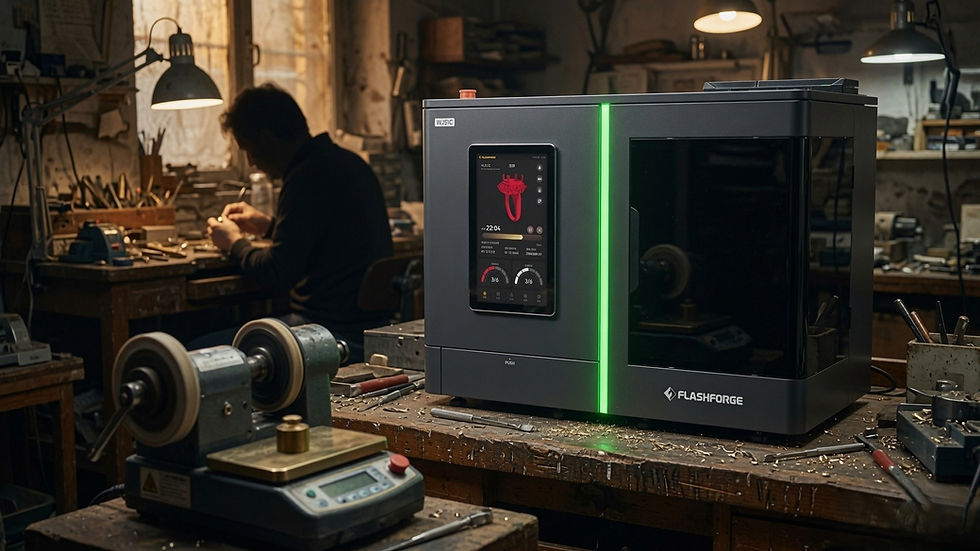
Flashforge WaxJet technology prints the model in a castable wax material while building a separate support structure around delicate or overhanging features. The resulting pattern is a true wax model intended for investment casting, rather than a brittle resin approximation that may demand a different burnout approach.
Once printing is complete, the parts are placed in an IPA bath on a magnetic stirrer. The agitation dissolves the support wax, leaving the castable model cleanly exposed without manual cutting, scraping or the risk of damaging fine details. This hands-free support removal is especially useful for patterns with complex undercuts, internal spaces and closely spaced elements.
After drying and inspection, the wax patterns are ready to be attached to a tree, invested and taken through the workshop's established burnout and casting process. As with any production method, casting success depends on sound treeing, investment practice, kiln control and alloy-specific expertise. The printer provides a reliable pattern source; it does not remove the value of a skilled caster.
The production benefits that matter
The most immediate benefit is responsiveness. A workshop can move from approved digital model to physical wax pattern without waiting on an external bureau. That can support faster client approvals, reduce interruption to bench work and make small-batch production more practical.
Accuracy matters just as much. When a design contains calibrated gemstones, repeating decorative elements or tight mechanical relationships, a pattern must faithfully express the CAD geometry. Consistent wax printing helps maintain the intended dimensions from one production cycle to the next, giving setters and finishers a more predictable starting point.
Surface quality also has a direct effect on labour. A clean, detailed wax pattern can reduce the correction required after casting, although it will never eliminate finishing altogether. Polishing, setting and final refinement remain where craftsmanship brings the piece to life. The aim is to avoid introducing unnecessary work before those considered finishing stages begin.
For a growing jewellery brand, in-house production can also improve planning. Samples, client commissions and small collections no longer need to compete for an outsourced supplier's turnaround. Priorities can be adjusted within the workshop, provided the printer, materials and post-processing routine are managed with care.
Choosing a wax workflow, not just a printer
Not every 3D printer is suited to jewellery casting. Resin systems can have a place in concept models, display pieces and certain casting applications, but their handling, support removal and burnout characteristics differ from wax. For workshops seeking dependable cast-ready patterns, the material and the full workflow deserve as much attention as the printer itself.
A jewellery-specific system should be assessed against the work it will actually perform. Consider the level of detail required, expected print volume, the size of typical jobs and the range of alloys and casting methods used in the workshop. It is also worth considering who will operate the equipment on a busy production day. The best system is one that fits naturally into the team's existing discipline.
Consumables are not an afterthought. Reliable wax and support materials help maintain consistent print quality and clean support removal. A supply interruption or unsuitable material can affect delivery promises just as readily as a mechanical fault. For that reason, local stock, informed technical advice and responsive service are part of the production decision.
Where the trade-offs sit
Bringing printing in-house requires an upfront investment, designated bench space and a clear process for handling IPA and consumables safely. Staff need training in file preparation, print scheduling, cleaning and routine maintenance. For a workshop printing only a handful of models each year, outsourcing may remain the more economical choice.
The equation changes when turnaround, confidentiality, iteration and production control are central to the business. A custom jeweller who regularly revises designs, or an atelier producing frequent small runs, can gain more than speed. It gains the ability to make production decisions at the point where design and craftsmanship meet.
Keeping the workflow dependable
Consistency comes from routine. Files should be checked before release, materials should be stored and handled according to their requirements, and printed patterns should be inspected before investment. Keeping the IPA bath and magnetic stirrer maintained helps ensure support wax dissolves evenly and patterns emerge cleanly.
It also pays to establish a simple internal record of successful print orientations, support strategies and casting outcomes for recurring design types. Over time, this becomes workshop knowledge that improves predictability across rings, pendants, earrings and more complex bespoke pieces.
Equipment support matters most when a production deadline is close. A supplier focused on jewellery understands that a paused printer can affect a client collection, a casting day and a workshop's reputation. 3D Werk supports professional jewellery teams with Flashforge WaxJet systems, casting consumables and direct technical assistance intended to keep the workflow moving.
In-house wax printing is not about replacing the judgement of the jeweller. It is about placing a precise, reliable tool beside it, so a well-resolved digital design can become a clean wax pattern at the moment the workshop is ready to create it.


Comments