WJ51C - World's First Desktop Wax 3D Printer for Jewelry
- Nico
- Jul 24
- 5 min read
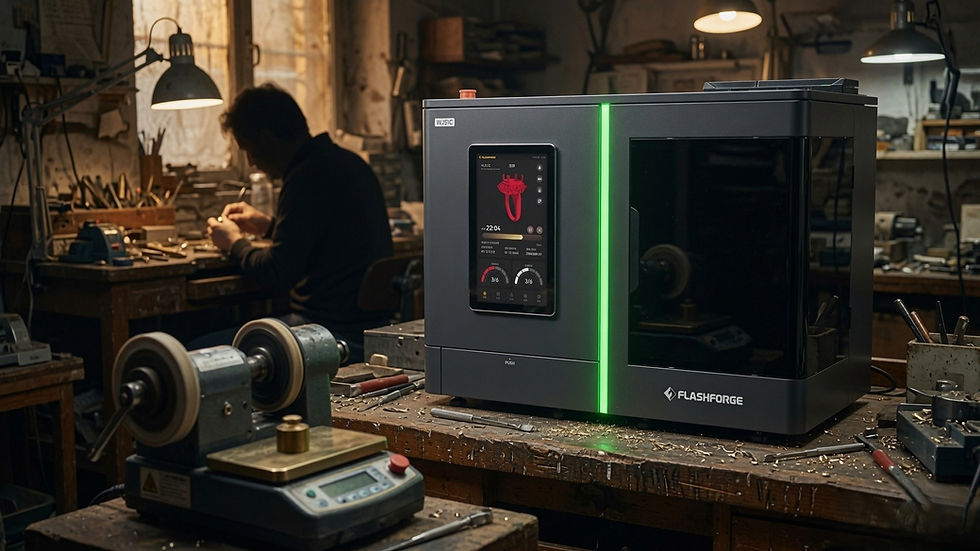
A fine jewellery design can be lost long before it reaches the bench. A softened edge, a distorted setting or support marks across a visible surface can turn an excellent CAD model into extra finishing time. The WJ51C - World's First Desktop Wax 3D Printer for Jewellery - is designed to protect the detail that matters, producing cast-ready wax patterns within a compact, professional desktop workflow.
For jewellery makers and workshops, this is not simply a faster route to a prototype. It is a practical production tool for bringing intricate digital designs into the lost-wax casting process with greater consistency, control and confidence. Where precision meets craftsmanship, the printer quietly supports the work rather than changing its character.
Why a dedicated wax printer changes the jewellery workflow
Manual wax carving remains invaluable for certain one-off forms, alterations and highly intuitive work. Yet it becomes difficult to sustain when a workshop is producing repeatable styles, complex pavé layouts, fine internal geometry or several client iterations at once. Outsourcing patterns can introduce delay, freight risk and less control over a job that may be changing daily.
A desktop wax printer places pattern production closer to the designer, jeweller and casting team. A CAD file can move from approved design to physical wax model without the compromises often associated with brittle resin patterns or manually built supports. This is particularly useful for custom engagement rings, signet rings, pendants, earrings and small production runs where dimensional accuracy affects every subsequent operation.
The WJ51C works with wax materials formulated for investment casting. The objective is clear: create finely resolved patterns that can be invested, burned out cleanly and cast with confidence. For a professional workshop, that outcome has greater value than a fast print alone. It reduces avoidable rework at the bench and gives the casting process a more dependable starting point.
How the WJ51C desktop wax printer works
The process begins with a properly prepared jewellery CAD model. Settings, wall thicknesses, stone seats and delicate connections should be reviewed as they would be for any casting method. The model is then arranged in the printer software, where the build is prepared for printing in casting wax alongside a separate support wax.
During printing, the WJ51C builds the model layer by layer. It deposits the model wax where the jewellery pattern belongs and support wax where temporary reinforcement is required. This enables complex geometry to be printed without forcing the designer to simplify undercuts, galleries or fine decorative features merely to make a pattern manufacturable.
Once the build is complete, the parts are removed and placed in an IPA bath. A magnetic stirrer circulates the solution to dissolve the support wax, leaving the model wax pattern behind. This hands-free support-removal process is one of the most useful distinctions in a professional wax workflow. It avoids the scraping, clipping and surface damage that can occur when supports must be removed mechanically from fragile patterns.
After cleaning and drying, the wax models are ready for inspection, treeing and investment. As with every casting process, care still matters. The appropriate investment, burnout cycle, metal and casting technique must suit the design and workshop practice. A high-quality wax pattern improves the starting point, but it does not remove the need for sound casting discipline.
WJ51C wax patterns for fine detail and clean burnout
Jewellery production rewards accuracy at a very small scale. Sharp shoulders, clean channel walls, defined engraving and accurate settings all affect the final metal piece. When the original wax pattern is faithful to the CAD file, the workshop spends less time correcting preventable variation after casting.
WaxJet technology is particularly relevant where surface quality and delicate geometry are non-negotiable. The purpose is not to eliminate finishing - hand finishing remains central to fine jewellery - but to ensure that polishing, setting and detailing begin from a cleaner, more predictable casting. It is an important distinction. Time saved on repairing print artefacts can be directed towards the craftsmanship clients see and feel.
Clean burnout is equally significant. Residue from unsuitable pattern materials can create uncertainty in the mould and complicate casting results. A dedicated casting wax workflow is designed to integrate with conventional lost-wax investment processes, helping workshops maintain confidence across the full journey from screen to sprue.
A more controlled path from CAD to casting
For design studios and boutique brands, in-house wax printing can improve more than turnaround time. It creates a clearer approval process. A client can assess proportion, finger coverage, profile and practical wearability from a physical pattern before precious metal is committed. Alterations can be made while the design is still digital, rather than after a costly casting.
For manufacturing workshops, the advantage is repeatability. Once a design has been validated, the same file can be prepared again when a reorder arrives or when a matching piece is required. This supports consistent production without requiring a master wax to be stored, protected and repeatedly handled.
The right operating rhythm depends on the workshop. A custom jeweller may use the WJ51C for approved commissions and urgent replacements. A production atelier may batch multiple designs to make better use of each print run. In both cases, the printer supports a more orderly handover between design, pattern preparation, casting and bench work.
Where the WJ51C fits best
The WJ51C is a strong fit for businesses that require professional casting patterns but do not need the footprint or production scale of a large industrial system. Its desktop format makes it particularly relevant to studios, specialist ateliers and manufacturing workshops seeking control without dedicating excessive floor space to pattern production.
It is not necessarily the answer to every job. A single experimental sculptural piece may still be best explored by hand in wax. Very high-volume production may require a different equipment and throughput strategy. The value of the WJ51C is most evident when a workshop needs regular access to accurate, castable patterns, fast design iteration and consistent finishing standards.
Material handling, cleaning procedures and print preparation also deserve attention. Like any production equipment, a wax printer performs best when operators follow a disciplined process and use compatible consumables. Reliable output is built from the relationship between the machine, the materials, the casting method and the people operating them.
Local expertise protects production continuity
A jewellery printer should not be treated as a standalone purchase. When a deadline is approaching, access to correct materials, informed troubleshooting and responsive technical support matters as much as the machine itself. Production continuity is protected by having a supplier who understands the jewellery casting workflow, rather than simply the equipment category.
For Sydney jewellery professionals, 3D Werk provides the WJ51C within an end-to-end approach that includes wax-printing materials, casting consumables, local service and technical guidance. This creates a more accountable path to adoption, from initial workflow planning through to day-to-day operation.
The most useful technology leaves more room for judgement, design and finishing at the bench. With cast-ready wax patterns, clean burnout and support removal handled through a controlled process, the WJ51C gives jewellery professionals a refined way to keep precision close to the craft.


Comments